
Can digital services for agriculture contribute to resilient TFP growth in sub-Saharan Africa?
By Jessica Agnew, Harrison Byrnes, Okeyo Mwai
Introduction
In sub-Saharan Africa, agricultural output held a steady rate of growth between the 1980s and 2000s, with a slowing in the last decade. Increased output resulted primarily from introducing new land into agricultural production and marginal contributions from uptakes of technologies such as use improved seed varieties and agronomic practices. However, these are not viable approaches for growing the agriculture sector in the long-term. Tim Njagi, Research Fellow at Tegemeo Institute in Kenya, emphasized this in his remarks at the Accelerating Agricultural Productivity Growth in East Africa: Agenda for urgent action event held in Nairobi in June 2022. “We can no longer rely on land expansion as a means of growing agricultural output, climate change has made land less productive”, Njagi said. Investments in agriculture research and development to create new technologies and attractive returns for private sector investors will be essential for SSA to drive output growth through improved total factor productivity (TFP). Further, increasing TFP in SSA can make a critical contribution global agricultural productivity, which is desperately needed as growth slows among industrialized countries.
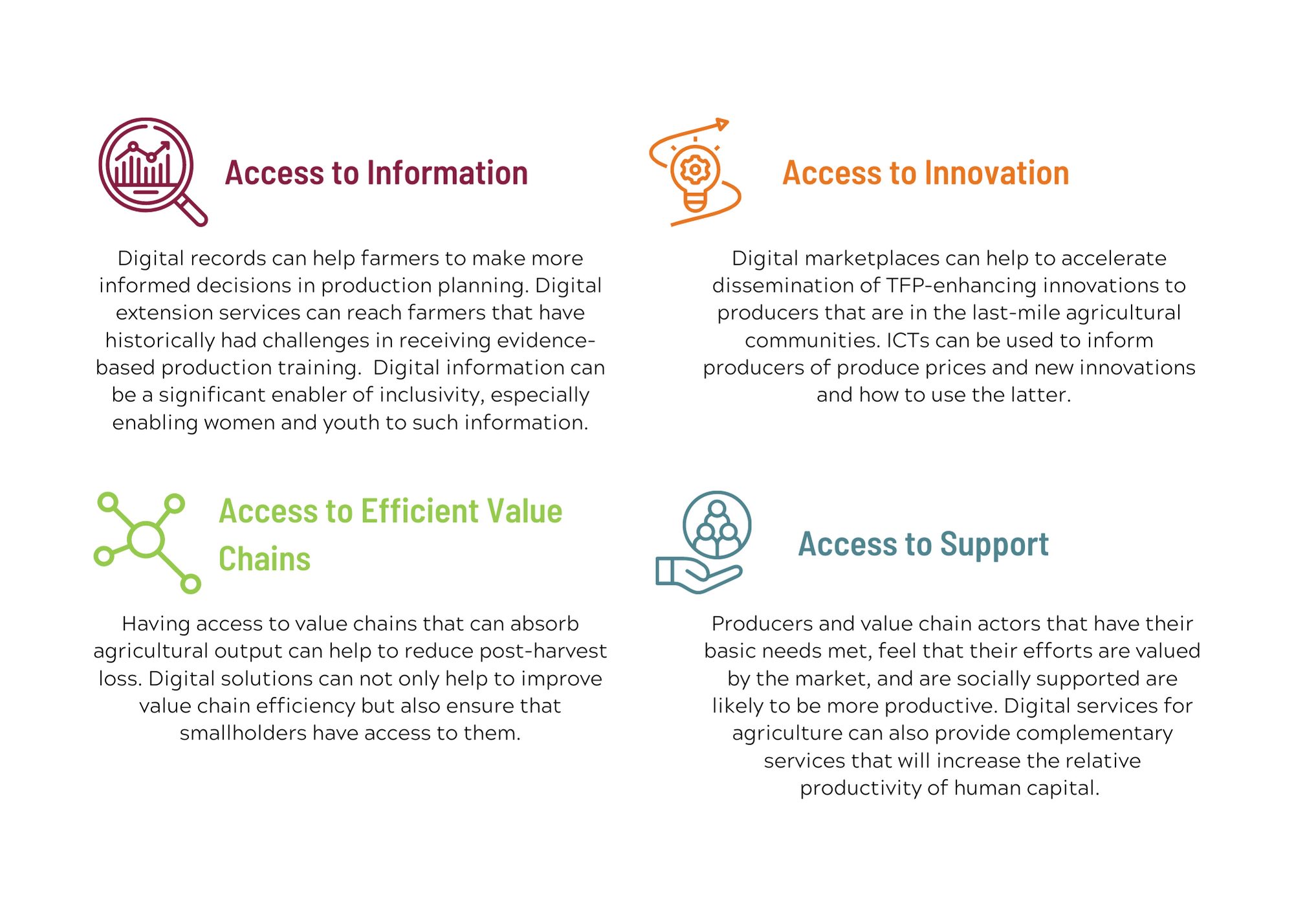
Digital services for agriculture (DSAs) have demonstrated success in improving agricultural productivity in an industrialized country context. Defined as “a solution that uses digital equipment and devices such as mobile phones, computers, satellites, and sensors to solve problems in agriculture,” DSAs have been widely touted as the next great opportunity for the transformation of African agriculture. Today there are more than 437 DSAs on the market in SSA, with Nigeria and Kenya tied for the top number of offerings (around 90). Digitization can contribute to TFP growth by increasing access to information,, diffusing innovations to last-mile agricultural communities, increasing value chain functionality, and creating positive feedback loops in human capital development.
Despite proliferation in the market and growing interest in using digital solutions, DSAs have not yet generated returns to TFP growth in the SSA context due to underutilization, lack of product ‘stickiness’, and challenges in reaching scale. Of the 437 DSAs on the market, only 3% have passed the 1 million user mark, and of these only an average of 30% of users are active. There are three tenets that actors in the innovation ecosystem must address to achieve the scale and success required for digitization to contribute to trending and resilient TFP growth – (1) DSAs must create adequate value for the user; (2) supporting infrastructure must be consistent and reliable; and (3) there must an adequate and integrated enabling environment for digitizing agriculture. We discuss each of these tenets and explore an example of a blockchain-powered DSA that considers these aspects in their digital service design, business model, and advocacy.
 DSAs must create adequate value for the user.
For DSAs to significantly and sustainably contribute to TFP growth, the user must be interested in and able to use the service and it must generate sufficient value so as to produce stickiness – frequent and sustained use over time. For smallholder farmers with constrained and seasonally fluctuating income, affordability and timing of payment schemes are a central value driver. Digital platforms (of which DSAs are a subset) that aggregate complementary services along with other features such as online and offline functionality, quality and reliability, and increased social support are more likely to create higher value and stickiness than those that offer single solutions. Value propositions that include rewarding loyalty, upholding trust, reduce information asymmetry, and offer customizable services are likely to be more successful at helping smallholder farmers overcome the multiple types of challenges they face. According to likely users of DSAs in Kenya, this will help to overcome underutilization and barriers to scale.
Supporting infrastructure must be consistent and reliable.
One of the most commonly cited reasons for the underutilization of DSAs in the SSA context is the lack of connectivity. Kenya demonstrates, however, that improving ICT service delivery is only one part of the supporting infrastructure required for sustained use of DSAs. Service providers must consider how they will support the transfer of digital skills to a population with limited familiarity with advanced digital technologies. According to one potential DSA user, service providers should offer “tutorials and quick lessons; building confidence to farmers by visiting their farms and advis(ing) accordingly.” In the initial stages, translation of the tutorial into local languages may be necessary.
Working in tandem with the public sector, extension models could be evolved to incorporate training on emerging DSAs and transfer digital literacy. Reskilling extension agents, including providing them with evidence of impact and success, will help to accelerate the adoption of DSAs in SSA as extension systems play a critical role in transferring technologies, information, and skills to farmers. Innovatively packaged DSAs can provide critical insights on the barriers to adoption and key value drivers to service providers, policymakers, and other key stakeholders in the innovation ecosystem. By building out community engaged higher education, universities can also be a key player in disseminating training and evidence of DSAs’ contribution to improved agricultural productivity and profitability. Partnerships between tech companies, research institutions, and universities have demonstrated that working in collaboration to disseminate training and evidence generation leads to increased adoption and ability to overcome challenges to DSA adoption in Western Kenya.
There must be an adequate and integrated enabling environment for digitizing agriculture.
The innovative value proposition of DSAs alone will not be sufficient to create agricultural transformation. The proliferation of standalone DSAs has resulted in a fragmented digital innovation ecosystem, that has led to underutilization and impeded scale up of adoption. Policies that prioritize the right of its citizenry to access digital agricultural extension, like those in Kenya, help to provide the enabling environment needed innovation dissemination. Policies that consider data security and authenticity will also be required in order to ensure consumer confidence in DSAs that use their data and offer insights in return. Other policies that are needed to create a healthy enabling environment for DSAs to reach adequate and sustained scale include those that will incentivize adequate growth-stage capital, lead to the development of robust and scalable business models (not just products), and support the infrastructure for robust digital stacks. This type of enabling environment will allow stakeholders across sectors to leverage economies of digital scale that can be leveraged to produce TFP that is resilient to shocks and lead to long-term trending growth.
Blockchain Technology Improves Productivity Through Better Value Chain Functionality
In Western Kenya, African indigenous vegetables support livelihoods through their nutrient packed leaves and by offering short growing cycles and high demand that can be used to supplement incomes, especially for women. In May 2021, a select number of AIV value chain actors received phones containing the AgUnity platform. AgUnity, an Australian tech start-up, develops and deploys low cost, blockchain based technology solutions to build efficient digital supply chains, from farmer to consumer. A study conducted by Virginia Tech and Egerton University showed that the reliable digital transacting and record keeping features of the blockchain-powered platform led to improved value chain functionality – transaction costs were reduced, value chain actors cooperated, quality increased, incomes increased and yields increased.
So, what does this have to do with productivity? Through improved value chain functionality, increased productivity was observed among the participating smallholder producers. This primarily resulted reducing post-harvest loss – increased total output with the same amount of inputs. Since AgUnity’s blockchain-powered app ensures that all transaction details are reliable and transparently recorded, producers, traders, and retailer users preferred to transact with other users of the application because of the increased trust the system provides. Producers stopped harvesting prior to finding a buyer and would only harvest what the buyers were looking for. Traders only ordered the varieties demanded by the retailer and consumer from the producer. The blockchain-based record keeping functionality of the platform also helped inform producers about the varieties and quantities that were demanded and they worked collaboratively to change production cycles to better meet market demand.
The AgUnity platform offers value generation features that are likely to produce stickiness among consumers – it creates network effects, reduces information asymmetry, and reduces search cost. However, perhaps even more critically, it is designed to be a DSA aggregator, eventually offering complementary services (i.e., weather information, extension advisory services, marketplace) in one user friendly location that could create a multiplier effect on TFP growth. The AgUnity platform is also designed to allow the user autonomy over their data sharing. Working collaboratively with stakeholders across the agricultural sector, a data sharing scheme can be designed to support smallholder producers even more effectively.